Association of excess body weight above ideal body weight with gestational diabetes mellitus in Bangladesh: A single-center cross-sectional study
Keywords:
Gestational diabetes mellitus, Bangladesh, South Asia, Ideal body weight, Obesity, BMI, PregnancyAbstract
Background: Gestational diabetes mellitus (GDM) is an increasing public health concern in South Asia, where women may develop dysglycemia at lower body mass indices (BMI) than in Western populations. Excess weight above ideal body weight (EW-IBW) may provide additional anthropometric information associated with GDM risk.
Objective: To evaluate the association between EW-IBW and GDM among Bangladeshi women and compare the discriminatory performance of EW-IBW and BMI.
Methods: This hospital-based cross-sectional study included 993 pregnant women attending antenatal care at Ad-din Women’s Medical College Hospital, Dhaka, Bangladesh, between January and December 2024. GDM was diagnosed according to the IADPSG criteria. EW-IBW was calculated using the Broca and Modified Devine methods. Multivariable logistic regression adjusted for maternal age, parity, residence, family history of diabetes, previous GDM, obesity, and history of PCOS.
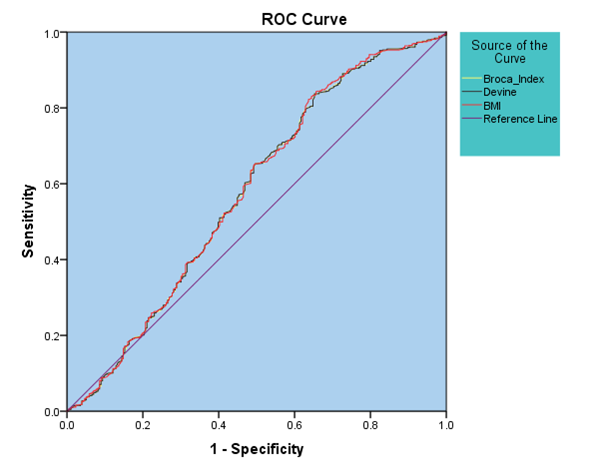
Results: Women with GDM had significantly higher overweight/obesity prevalence than non-GDM women (67.25% vs 54.29%, p<0.001). Previous history of GDM and urban residence were also significantly associated with GDM. ROC analysis showed poor discriminatory performance for BMI (AUC 0.577) and EW-IBW [Broca Index (AUC 0.576), Modified Devine method (AUC 0.576)].
Conclusion: Although obesity was significantly associated with GDM, BMI and EW-IBW alone demonstrated poor discriminatory performance and should not be considered independent screening tools.
[J Assoc Clin Endocrinol Diabetol Bangladesh, July 2026; 5 (2): e89524]
0
0
References
1. Poston L, Caleyachetty R, Cnattingius S, Corvalán C, Uauy R, Herring S, et al. Preconceptional and maternal obesity: epidemiology and health consequences. Lancet Diabetes Endocrinol. 2016;4(12):1025–36.
DOI: https://doi.org/10.1016/s2213-8587(16)30217-0
2. Song Z, Cheng Y, Li T, Fan Y, Zhang Q, Cheng H. Effects of obesity indices/GDM on the pregnancy outcomes in Chinese women: A retrospective cohort study. Front Endocrinol (Lausanne). 2022;13:1029978.
DOI: https://doi.org/10.3389/FENDO.2022.1029978
3. Read SH, Rosella LC, Berger H, Feig DS, Fleming K, Ray JG, et al. BMI and risk of gestational diabetes among women of South Asian and Chinese ethnicity: a population-based study. Diabetologia. 2021;64(4):805–13.
DOI: https://doi.org/10.1007/S00125-020-05356-5/FIGURES/2
4. Tabassum M, Mozaffor M, Muna FZ, Rahman MM, Khan MTI, Naznen F, et al. Visceral adiposity index: an effective tool for predicting metabolic syndrome in Bangladeshi adult population. Mugda Medical College Journal. 2022;5(2):88–92.
DOI: https://doi.org/10.3329/mumcj.v5i2.68807
5. Shah AD, Kandula NR, Lin F, Allison MA, Carr J, Herrington D, et al. Less favorable body composition and adipokines in South Asians compared to other U.S. ethnic groups: Results from the MASALA and MESA studies. Int J Obes (Lond). 2015;40(4):639.
DOI: https://doi.org/10.1038/IJO.2015.219
6. International Diabetes Federation. IDF Diabetes Atlas 2025: global diabetes data and insights [Internet]. Brussels: International Diabetes Federation; 2025 [cited 2025 May 26]. Available from: https://diabetesatlas.org/resources/idf-diabetes-atlas-2025/
7. Mazumder T, Akter E, Rahman SM, Islam MT, Talukder MR. Prevalence and risk factors of gestational diabetes mellitus in Bangladesh: Findings from Demographic Health Survey 2017–2018. Int J Environ Res Public Health. 2022;19(5):2583.
DOI: https://doi.org/10.3390/IJERPH19052583/S1
8. Panel IA of D and PSGC. International Association of Diabetes and Pregnancy Study Groups recommendations on the diagnosis and classification of hyperglycemia in pregnancy. Diabetes Care. 2010;33(3):676.
DOI: https://doi.org/10.2337/DC09-1848
9. Atlaw D, Sahiledengle B, Assefa T, Negash W, Tahir A, Regasa T, et al. Incidence and risk factors of gestational diabetes mellitus in Goba town, Southeast Ethiopia: a prospective cohort study. BMJ Open. 2022;12(9):e060694.
DOI: https://doi.org/10.1136/BMJOPEN-2021-060694
10. Amiri FN, Faramarzi M, Bakhtiari A, Omidvar S. Risk Factors for gestational diabetes mellitus: A case-control study. Am J Lifestyle Med. 2018;15(2):184.
DOI: https://doi.org/10.1177/1559827618791980
11. Joseph L. Fleiss BLMCP. determining sample sizes needed to detect a difference between two proportions. In: Statistical methods for rates and proportions [Internet]. John Wiley & Sons, Ltd; 2003 [cited 2026 Jul 13]. p. 64–85. Available from: https://onlinelibrary.wiley.com/doi/full/10.1002/0471445428.ch4
DOI: https://doi.org/10.1002/0471445428.CH4
12. Begum R, Roy S, Banik S. The prevalence of gestational diabetes mellitus in Bangladesh: a systematic review and meta-analysis. Int J Diabetes Dev Ctries. 2022;42(4):606–13.
DOI: https://doi.org/10.1007/S13410-022-01091-2
13. Dong B, Yu H, Wei Q, Zhi M, Wu C, Zhu X, et al. The effect of pre-pregnancy body mass index and excessive gestational weight gain on the risk of gestational diabetes in advanced maternal age. Oncotarget. 2017;8(35):58364.
DOI: https://doi.org/10.18632/ONCOTARGET.17651
14. Anand SS, Gupta M, Teo KK, Schulze KM, Desai D, Abdalla N, et al. Causes and consequences of gestational diabetes in South Asians living in Canada: results from a prospective cohort study. CMAJ Open. 2017;5(3):E604.
DOI: https://doi.org/10.9778/CMAJO.20170027
15. Torloni MR, Betrán AP, Horta BL, Nakamura MU, Atallah AN, Moron AF, et al. Prepregnancy BMI and the risk of gestational diabetes: a systematic review of the literature with meta-analysis. Obes Rev. 2009;10(2):194–203.
DOI: https://doi.org/10.1111/J.1467-789X.2008.00541.X
16. Pan SY, Huang CJ, Cheng HM. Risk factors and prevention strategies for gestational diabetes in Asian populations. JACC Asia. 2024;4(11):853.
DOI: https://doi.org/10.1016/J.JACASI.2024.08.013
17. Sperling MM, Leonard SA, Blumenfeld YJ, Carmichael SL, Chueh J. Prepregnancy body mass index and gestational diabetes mellitus across Asian and Pacific Islander subgroups in California. AJOG Global Reports. 2023;3(1):100148.
DOI: https://doi.org/10.1016/J.XAGR.2022.100148
18. Iqbal R, Rafique G, Badruddin S, Qureshi R, Cue R, Gray-Donald K. Increased body fat percentage and physical inactivity are independent predictors of gestational diabetes mellitus in South Asian women. Eur J Clin Nutr. 2007;61(6):736–42.
DOI: https://doi.org/10.1038/SJ.EJCN.1602574
19. Misra A, Soares MJ, Mohan V, Anoop S, Abhishek V, Vaidya R, et al. Body fat, metabolic syndrome and hyperglycemia in South Asians. J Diabetes Complications. 2018;32(11):1068–75.
DOI: https://doi.org/10.1016/J.JDIACOMP.2018.08.001
20. Cheema A, Adeloye D, Sidhu S, Sridhar D, Chan KY. Urbanization and prevalence of type 2 diabetes in Southern Asia: A systematic analysis. J Glob Health. 2014;4(1):010404.
Downloads
Published
How to Cite
Issue
Section
License
Copyright (c) 2026 Mohammad Moin Shahid

This work is licensed under a Creative Commons Attribution-NonCommercial 4.0 International License.
Articles in the JACEDB are licensed under a Creative Commons CC BY-NC License Attribution-Noncommercial 4.0 International (CC BY-NC 4.0). This license permits Share— copy and redistribute the material in any medium or format, Adapt — remix, transform, and build upon the material.

