For Authors
General information
Journal of Association of Clinical Endocrinologist and Diabetologist of Bangladesh (JACEDB) is the official publication of the Association of Clinical Endocrinologist and Diabetologist of Bangladesh (ACEDB). JACEDB has been launched in January 2022. It is recognized by Bangladesh Medical and Dental Council (BMDC) (S/N - 170).
This Journal aims to publish scientifically written, evidence-based, clinical practice and healthcare research related to Endocrinology, Diabetology, and Metabolic disorders. Manuscripts should present novel findings addressing significant questions in clinical medicine research and practice, in the form of original article, editorial, review, short communication, case report, letter to the editor, and others maintaining ethics.
The journal adheres to the Committee on Publication Ethics (COPE) standards. JACEDB is published twice a year (January and July). This Journal provides immediate open access to its content on the principle that making research freely available to the public supports greater global knowledge exchange. This is a non-profit journal and currently has no article processing fee.
The following are the minimum requirements for manuscripts submitted for publication, which are based on updated recommendations for the conduct, reporting, editing, and publication of scholarly work in medical journals by the International Committee of Medical Journal Editors (ICMJE). Web site of ICMJE is www.icmje.org.
Author guideline
Submission of manuscripts
All manuscripts need to be submitted online through the link below:
https://www.banglajol.info/index.php/JACEDB/about/submissions
Alternatively, manuscripts can be submitted to the Chief Editor of JACEDB through the following email: journal.acedb@gmail.com
Submitted manuscripts that do not comply with the "Instructions to Authors" will be returned to the authors for technical correction before undergoing editorial and peer review.
Preparing a Manuscript
- Authors should keep their manuscripts as short as they reasonably can
- Page numbers should appear in the lower-right corner of each page, beginning with the title page.
- The language of the manuscript must be simple, explicit, and American-style English
- Authors'/Co-authors' names or any other identification should not appear anywhere in the body of the manuscript to facilitate blind review.
Component of a manuscript
- Covering letter
- Title page
- Main text
Covering letter
It should contain (follow the template):
- Explain to the Chief Editor why your paper should be published in The JACEDB rather than elsewhere.
- Authorship form including ORCID ID
- Acknowledgement
- Declarations: conflict of interest, funding statement (https://www.icmje.org/disclosure-of-interest/)
- Name of IRB, protocol number, registration number, and registry name for clinical trial
Click here to download the cover letter template.
Title page
The title page must contain the following information:
- Title of the article: Must be informative, specific, and short, and not exceed 100 words.
- Running title: A short running title of not more than 40 characters should be given.
- Authors’ names with affiliations (during the conduction of research): Full names, departments, institutions, city, and country of all co-authors.
- Full name, current postal address, e-mail, and cell number of the corresponding author.
- Word count: Abstract and main text excluding references, figures, and tables.
- Number of tables and figures
Click here to download the title page template.
Main text
It should be written according to the types of manuscripts.
Types of Manuscript
The following categories of manuscripts are accepted for this Journal:
|
Sl. |
Type of article |
Max abstract word count |
Max text word count |
Max no. of tables or figures |
Max no. of references |
|
1. |
Meta-analysis and systematic review |
300 |
3000 |
6 |
40 |
|
2. |
Original research |
300 |
3000 |
5 |
30 |
|
3. |
Short communication |
200 |
2000 |
2 |
20 |
|
4. |
Review article |
200 |
5000 |
8 |
50 |
|
5. |
Letter to the editor |
No |
1000 |
1 |
5 |
|
6. |
Case report |
150 |
1500 |
4 |
15 |
Structure of manuscript
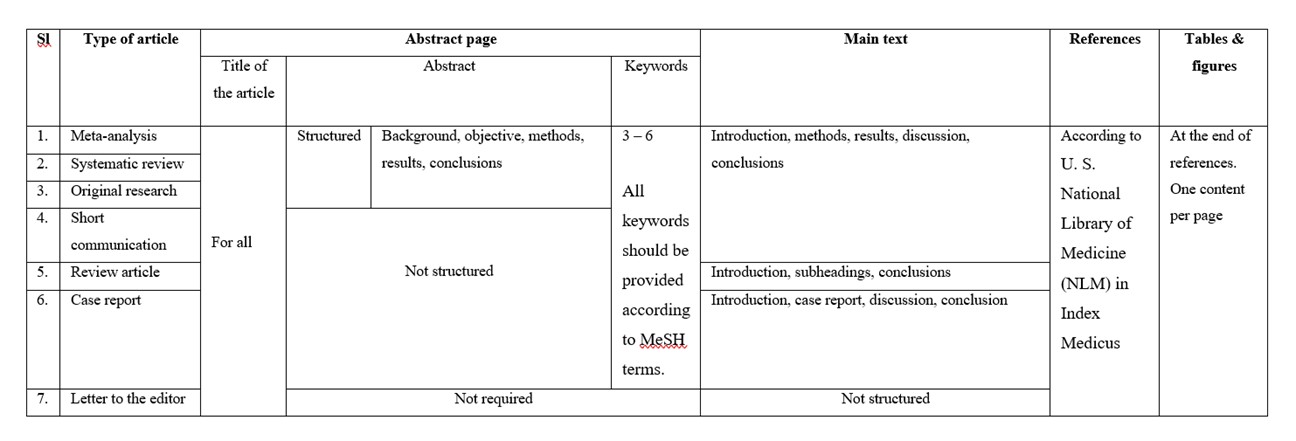
Reporting guideline
Articles should be reported using the EQUATOR (Enhancing the Quality and Transparency of Health Research) checklist. Some of the reporting guidelines for common study designs are (https://www.equator-network.org/):
|
Study design |
Reporting guideline |
|
Randomized controlled trial |
CONSORT |
|
Systematic review |
PRISMA |
|
Observational studies |
STROBE |
|
Case reports |
CARE |
|
Qualitative research |
ARRIVE |
In-text citation
Number references consecutively in order of their appearance in the text. Identify references in text, tables, and legends by Arabic numerals as superscripts after a full stop.
e.g., We present here the weighting process from the recently conducted NMHS 2019 and test it for quality.9,11
Several studies found similar findings.3,7-11, 13
References
References should follow the standards summarized in the NLM’s Sample References webpage (https://www.nlm.nih.gov/bsd/uniform_requirements.html) and detailed in the NLM’s Citing Medicine, 2nd edition. Where available, URLs or doi for the references should be provided at last.
- Standard journal article: List the first six authors followed by et al.
Vega KJ, Pina I, Krevsky B. Heart transplantation is associated with an increased risk for pancreatobiliary disease. Ann Intern Med 1996 Jun 1;124(11):980-3
More than six authors: Parkin DM, Clayton D, Black RJ, Masuyer E, Friedl HP, Ivanov E, et al. Childhood leukaemia in Europe after Chernobyl: 5 year follow-up. Br J Cancer 1996;73:1006-12
- Organization as author
The Cardiac Society of Australia and New Zealand. Clinical exercise stress testing. Safety and performance guidelines. Med J Aust 1996; 164: 282-4
- No author given
Anonymous. Cancer in South Africa [editorial]. S Afr Med J 1994;84:15
- Article not in English (Note: NLM translates the title to English, encloses the translation in square brackets, and adds an abbreviated language designator.)
Ryder TE, Haukeland EA, Solhaug JH. Bilateral infrapatellar seneruptur hostidligere frisk kvinne. Tidsskr Nor Laegeforen 1996;116:41-2.
- Volume with supplement
Shen HM, Zhang QF. Risk assessment of nickel carcinogenicity and occupational lung cancer. Environ Health Perspect 1994;102 Suppl 1:275-82.
- Issue with supplement
Payne DK, Sullivan MD, Massie MJ. Women's psychological reactions to breast cancer. Semin Oncol 1996; 23(1 Suppl 2):89-97.
- Volume with part
Ozben T, Nacitarhan S, Tuncer N. Plasma and urine sialic acid in non-insulin dependent diabetes mellitus. Ann Clin Biochem 1995;32(Pt 3):303-6.
- Issue with part
Poole GH, Mills SM. One hundred consecutive cases of flap lacerations of the leg in ageing patients. N Z Med J 1994;107(986 Pt 1):377-8.
- Issue with no volume
Turan I, Wredmark T, Fellander-Tsai L. Arthroscopic ankle arthrodesis in rheumatoid arthritis. Clin Orthop 1995;(320):110-4.
- No issue or volume
Browell DA, Lennard TW. Immuno-logic status of the cancer patient and the effects of blood transfusion on antitumor responses. Curr Opin Gen Surg 1993:325-33.
- Pagination in Roman numerals
Fisher GA, Sikic BI. Drug resistance in clinical oncology and hematology. Introduction. Hematol Oncol Clin North Am 1995 Apr;9(2):xi-xii.
- Type of article indicated as needed
Enzensberger W, Fischer PA. Metronome in Parkinson's disease [letter]. Lancet 1996;347:1337.
Clement J, De Bock R. Hematological complications of hantavirus nephropathy (HVN) [abstract]. Kidney Int 1992;42:1285.
- Article containing retraction
Garey CE, Schwarzman AL, Rise ML, Seyfried TN. Ceruloplasmin gene defect associated with epilepsy in EL mice [retraction of Garey CE, Schwarzman AL, Rise ML, Seyfried TN. In: Nat Genet 1994;6:426-31]. Nat Genet 1995;11:104.
- Article retracted
Liou GI, Wang M, Matragoon S. Precocious IRBP gene expression during mouse development [retracted in Invest Ophthalmol Vis Sci 1994; 35:3127]. Invest Ophthalmol Vis Sci 1994;35:1083-8.
- Article with published erratum
Hamlin JA, Kahn AM. Herniography in symptomatic patients following inguinal hernia repair [published erratum appears in West J Med 1995;162:278]. West J Med 1995;162: 28-31. Books and Other Monographs
(Note: Previous Vancouver style incorrectly had a comma rather than a semicolon between the publisher and the date.)
- Personal author(s)
Ringsven MK, Bond D. Gerontology and leadership skills for nurses. 2nd ed. Albany (NY): Delmar Publishers; 1996.
- Editor(s), compiler(s) as author
Norman IJ, Redfern SJ, editors. Mental health care for elderly people. New York: Churchill Livingstone; 1996.
- Organization as author and publisher
Institute of Medicine (US). Looking at the future of the Medicaid program. Washington: The Institute; 1992.
- Chapter in a book
Phillips SJ, Whisnant JP. Hypertension and stroke. In: Laragh JH, Brenner BM, editors. Hypertension: Pathophysiology, diagnosis, and management. 2nd ed. New York: Raven Press; 1995. p. 465-78.
- Conference proceedings
Kimura J, Shibasaki H, editors. Recent advances in clinical neuro-physiology. Proceedings of the 10th International Congress of EMG and Clinical Neurophysiology; 1995 Oct 15-19; Kyoto, Japan. Amsterdam: Elsevier; 1996.
- Conference paper
Bengtsson S, Solheim BG. Enforcement of data protection, privacy, and security in medical informatics. In: Lun KC, Degoulet P, Piemme TE, Rienhoff O, editors. MEDINFO 92. Proceedings of the 7th World Congress on Medical Informatics; 1992 Sep 6-10; Geneva, Switzerland. Amsterdam: North-Holland; 1992. p. 1561-5
- Scientific or technical report
Issued by funding/sponsoring agency: Smith P, Golladay K. Payment for durable medical equipment billed during skilled nursing facility stays. Final report. Dallas (TX): Dept. of Health and Human Services (US), Office of Evaluation and Inspections; 1994 Oct. Report No.: HHSIGOEI69200860.
Issued by performing agency: Field MJ, Tranquada RE, Feasley JC, editors. Health services research: work force and educational issues. Washington: National Academy Press; 1995. Contract No.: AHCPR282942008. Sponsored by the Agency for Health Care Policy and Research.
- Dissertation/Thesis
Kaplan SJ. Post-hospital home health care: the elderly's access and utilization [Dissertation/Thesis]. St. Louis (MO): Washington Univ.; 1995.
- Patent: Larsen CE, Trip R, Johnson CR, inventors; Novoste Corporation, assignee. Methods for procedures related to the electrophysiology of the heart. US patent 5,529,067. 1995 Jun 25.
Other Published Material
- Newspaper article
Lee G. Hospitalizations tied to ozone pollution: study estimates 50,000 admissions annually. The Washington Post 1996 Jun 21;Sect. A:3 (col. 5).
- Audiovisual material
HIV+/AIDS: the facts and the future [videocassette]. St. Louis (MO): Mosby-Year Book; 1995.
- Legal material
Public law: Preventive Health Amendments of 1993, Pub. L. No. 103-183, 107 Stat. 2226 (Dec. 14, 1993). Unenacted bill: Medical Records Confidentiality Act of 1995, S. 1360, 104th Cong., 1st Sess. (1995)
Code of Federal Regulations: Informed Consent, 42 C.F.R. Sect. 441.257 (1995).
Hearing: Increased Drug Abuse: the Impact on the Nation's Emergency, Rooms: Hearings Before the Subcomm. On Human Resources and Intergovernmental Relations of the House Comm. On Government Operations, 103rd Cong., 1st Sess. (May 26, 1993).
- Map
North Carolina. Tuberculosis rates per 100,000 population, 1990 [demographic map]. Raleigh: North Carolina Dept. of Environment, Health, and Natural Resources, Div. of Epidemiology; 1991.
- Dictionary and similar references
Stedman's medical dictionary. 26th ed. Baltimore: Williams & Wilkins; 1995. Apraxia; p. 119-20.
- Classical material
The Winter's Tale: act 5, scene 1, lines 13-16. The complete works of William Shakespeare. London: Rex; 1973.
- In press
(Note: NLM prefers "forthcoming" because not all items will be printed.)
Leshner AI. Molecular mechanisms of cocaine addiction. N Engl J Med. In press 1996
Electronic Material
- Journal article in electronic format: Morse SS. Factors in the emergence of infectious diseases. Emerg Infect Dis [serial online] 1995 Jan-Mar [cited 1996 Jun 5];1(1):[24 screens].
Tables
Each table must be self-explanatory and presented in a way that is easy to understand without referring to the text. It should be typed with double spacing and numbered consecutively with Roman numerals (Table-I). Provide a short descriptive caption above each table with footnotes and/or explanations underneath. The number of observations, subjects, and units of numerical figures must be given. It is also important to mention whether the given values are mean, median, mean±SD, or mean±SEM. All significant results must be indicated using asterisks. Appropriate positions for the tables within the text may be indicated.
Checklist for Table
- Units of data given?
- ‘n’ mentioned?
- Mean ± SD or Mean ± SEM given?
- Statistical significance of groups indicated by asterisks or other markers?
- P values given?
- Rows and columns properly aligned?
Figures
Each figure must be numbered with Arabic numerals (Figure-1), and a short descriptive caption must be provided. All significant results should be indicated using asterisks. Legends for figures should be typed below the figure, if possible, or on a separate sheet.
Checklist for Figure
- Serially numbered?
- Self-explanatory caption given?
- X and Y axes graduated?
- X and Y axes titled (legend)?
- Units mentioned (if necessary)?
- Different symbols/markers for different groups given?
- SD or SEM represented (graphically)?
- Statistical significance indicated?
Images of patients
Our policy on obtaining consent for the publication of patient images is a subset of our general policy on patient confidentiality. If there is any chance that a patient may be identified from a photograph or other image or from its legend or accompanying text, we need the patient’s written consent to publication in the journal.
Images such as X-rays, laparoscopic images, ultrasound images, pathology slides, or images of indistinctive parts of the body may be used without consent, so long as they are anonymised by the removal of any identifying marks and are not accompanied by text that could reveal the patient’s identity through clinical or personal detail.
Style
- Abbreviations and symbols must be standard, and SI units must be used throughout except for blood pressure values, which are reported in mm Hg.
- Drugs should be given their approved generic name.
- Acronyms should be used sparingly and fully explained when first used.
- All abbreviations/acronyms should be fully stated in the text where they first appear and in parentheses. Subsequently, the abbreviation/acronym may only be used.
- Symbols such as ‘&’ should not be used.
Formatting of text
- Type a single space at the end of each sentence
- Do not use boldface for emphasis within text
- Use a comma before the final "and" or "or" in a list of items
- Numbers one to ten are written out in words unless they are used as a unit of measurement, except in figures and tables
- Numbers should be stated in words when they are the beginning of a sentence.
- Use single hard-returns to separate paragraphs. Do not use tabs or indents to start a paragraph
- Do not use the automated features of your software, such as hyphenation, endnotes, headers, or footers (especially for references).
Copyright Notice
Articles in the JACEDB are licensed under a Creative Commons CC BY-NC License Attribution-Noncommercial 4.0 International (CC BY-NC 4.0). This license permits Share— copy and redistribute the material in any medium or format, Adapt — remix, transform, and build upon the material.

