Diabetic nephropathy in young adults (<30 Years) with diabetes in Bangladesh: A cross-sectional observational study at a tertiary care center
Keywords:
Diabetic nephropathy, Young adult, Diabetes mellitusAbstract
Background: Microalbuminuria (MA) is the earliest clinical hallmark of diabetic nephropathy at which appropriate intervention can retard or reverse the progression of the disease. This aspect is not widely studied in young diabetic subjects of Bangladesh.
Objectives: To determine the frequency of diabetic nephropathy (DN) in young diabetic patients and to identify the risk factors associated with it.
Methods: This cross-sectional study included 88 participants [age: 26.19±3.33 years; body mass index (BMI, kg/m2): 25.42±5.39; mean±SD] with early-onset diabetes who were <30 years of age from the Department of Endocrinology, Bangladesh Medical University (BMU). The albumin-creatinine ratio (ACR) was estimated by immunoturbidometric assay. MA and macroalbuminuria were diagnosed if ACR was 30-300 mg/g of creatinine and >300 mg/g of creatinine, respectively. The estimated glomerular filtration rate (eGFR) was estimated by the CKD-EPI equation. Anthropometric measurements, as well as creatinine, were estimated along with fasting plasma glucose (FPG), postprandial plasma glucose (PPG), glycated hemoglobin (HbA1c), and lipid profile.
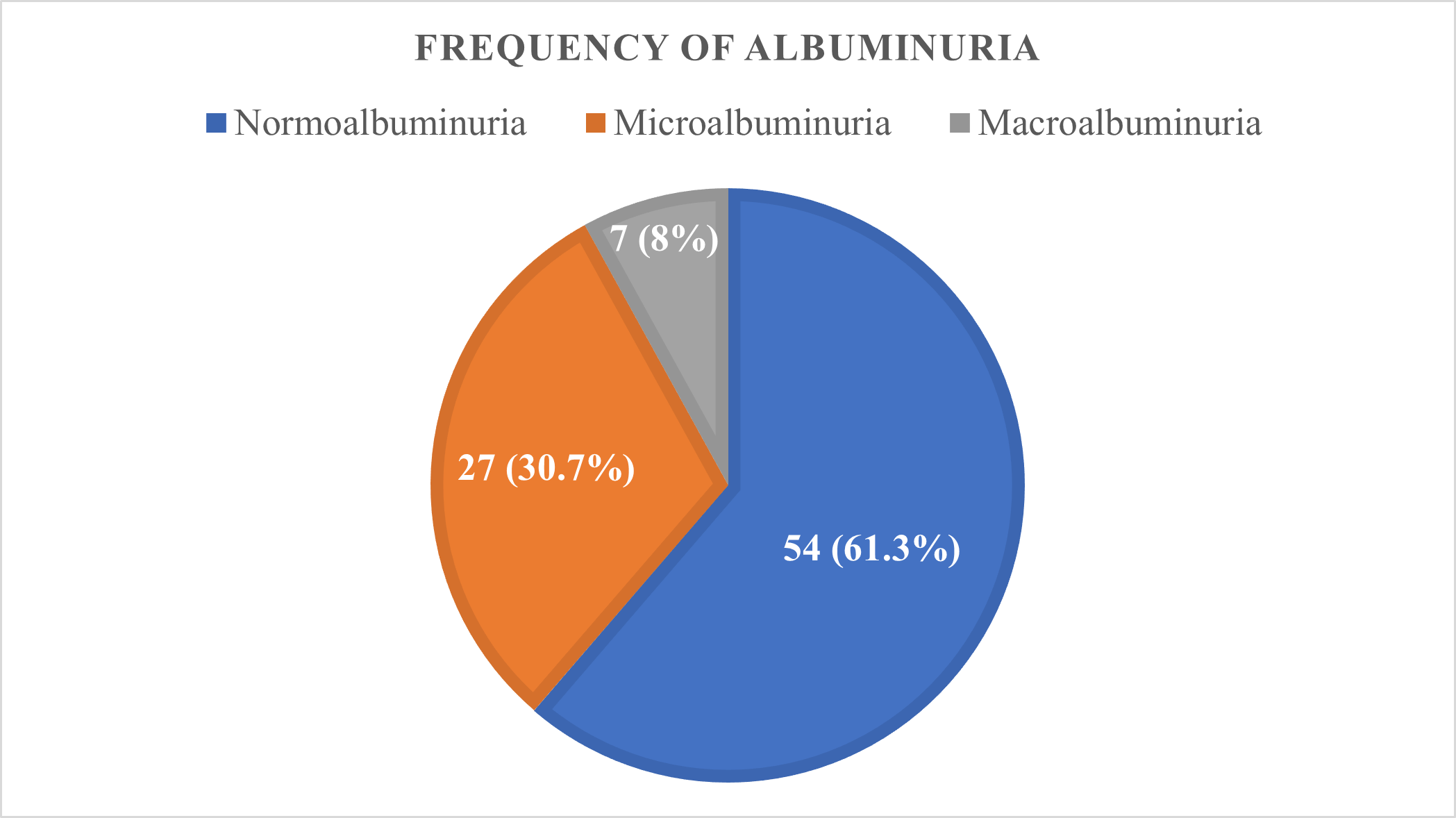
Results: The frequency of diabetic nephropathy was 38.7%, with 30.7% having MA and 8% having macroalbuminuria, and only 2.2% of patients had eGFR <60ml/min/1.73 m2. There was a significantly higher frequency of MA with longer diabetes duration (p=0.010), higher FPG (p=0.045), higher HbA1c (p=0.025), and hypertriglyceridemia (p=0.009). No significant association between MA and blood pressure, BMI, or waist circumference was found. Logistic regression analysis showed that diabetes duration (p=0.008) and triglycerides (p=0.044) were independent predictors of albuminuria.
Conclusions: The results of the study suggest a high frequency of diabetic nephropathy in young subjects. Longer duration of diabetes, hyperglycemia, and hypertriglyceridemia were important risk factors for nephropathy. So, the consequences of diabetes in the younger age group should not be overlooked.
[J Assoc Clin Endocrinol Diabetol Bangladesh, July 2026; 5 (2): 89844]
3
3
References
1. Magliano DJ, Boyko EJ, Atlas D. 3. The global picture of diabetes. In Diabetes Atlas [Internet]. 11th edition 2025. International Diabetes Federation. Available at https://www.ncbi.nlm.nih.gov/books/NBK618744/
2. Mayer-Davis EJ, Lawrence JM, Dabelea D, Divers J, Isom S, Dolan L, et al. Incidence trends of type 1 and type 2 diabetes among youths, 2002–2012. N Engl J Med. 2017;376(15):1419-29. DOI: https://doi.org/10.1056/nejmoa1610187
3. Hasan M, Morshed MS, Tofail T, Sultana N, Banu H, Rahman MA, et al. Early-Onset Type 2 Diabetes in Bangladesh: National Estimates and Risk Correlates. AACE Endocrinol Diabetes. 2026;13(2):222-32. DOI: https://doi.org/10.1016/j.aed.2025.12.005
4. Ke C, Sohal P, Qian H, Quan H, Khan NA. Diabetes in the young: a population‐based study of South Asian, Chinese and White people. Diabet Med. 2015;32(4):487-96. DOI: https://doi.org/10.1111/dme.12657
5. Duncan BB, Magliano DJ, Boyko EJ. IDF Diabetes Atlas 11th edition 2025: global prevalence and projections for 2050. Nephrol Dial Transplant. 2025;41(1):7-9. DOI: https://doi.org/10.1093/ndt/gfaf177
6. Netayawijit P, Chansanam W, Sorn-In K. Interpretable machine learning framework for diabetes prediction: Integrating SMOTE balancing with SHAP explainability for clinical decision support. Healthcare 2025;13(20):2588. DOI: https://doi.org/10.3390/healthcare13202588
7. Grams ME, Melamed ML. Chronic Kidney Disease. Ann Intern Med. 2025;178(9):129-144. DOI: https://doi.org/10.7326/annals-25-02684
8. Stevens PE, Ahmed SB, Carrero JJ, Foster B, Francis A, Hall RK, et al. KDIGO 2024 clinical practice guideline for the evaluation and management of chronic kidney disease. Kidney Int. 2024;105(4):S117-314. DOI: https://doi.org/10.1016/j.kint.2023.10.018
9. Shah AS, Barrientos-Pérez M, Chang N, Fu JF, Hannon TS, Kelsey M, et al. ISPAD clinical practice consensus guidelines 2024: type 2 diabetes in children and adolescents. Horm Res Paediatr. 2024;97(6):555-83. DOI: https://doi.org/10.1159/000543033
10. Saito H, Tanabe H, Hirai H, Higa M, Tanaka K, Yamaguchi S, et al. Young-onset type 2 diabetes mellitus enhances proteinuria, but not glomerular filtration rate decline: A Japanese cohort study. J Diabetes Investig. 2024;15(10):1444-1456. DOI: https://doi.org/10.1111/jdi.14272
11. American Diabetes Association Professional Practice Committee for Diabetes. 11. Chronic kidney disease and risk management: Standards of care in diabetes-2026. Diabetes Care. 2026;49(Supplement_1):S246-S260. DOI: https://doi.org/10.2337/dc26-s011
12. Eppens MC, Craig ME, Cusumano J, Hing S, Chan AK, Howard NJ, et al. Prevalence of diabetes complications in adolescents with type 2 compared with type 1 diabetes. Diabetes care. 2006;29(6):1300-6. DOI: https://doi.org/10.2337/dc05-2470
13. American Diabetes Association Professional Practice Committee for Diabetes. 2. Diagnosis and classification of diabetes: Standards of care in diabetes-2026. Diabetes Care. 2026;49(Supplement_1):S27-S49. DOI: https://doi.org/10.2337/dc26-s002
14. Cavalier E, Zima T, Datta P, Makris K, Schaeffner E, Langlois M, et al. Recommendations for European laboratories based on the KDIGO 2024 clinical practice guideline for the evaluation and management of chronic kidney disease. Clin Chem Lab Med. 2025;63(3):525-34. DOI: https://doi.org/10.1515/cclm-2024-1082
15. Zhang L, Jiang L, Xu R, Zhang X, Zhang B, Yue R. Epidemiological research on diabetic nephropathy at global, regional, and national levels from 1990 to 2021: an analysis derived from the global burden of disease 2021 study. Front Endocrinol. 2025;16:1647064. DOI: https://doi.org/10.3389/fendo.2025.1647064
16. Zabeen B, Nahar J, Islam N, Azad K, Donaghue K. Risk factors associated with microalbuminuria in children and adolescents with diabetes in Bangladesh. Indian J Endocrinol Metab. 2018;22(1):85-8. DOI: https://doi.org/10.4103/ijem.ijem_269_17
17. Maahs DM, Snively BM, Bell RA, Dolan L, Hirsch I, Imperatore G, et al. Higher prevalence of elevated albumin excretion in youth with type 2 than type 1 diabetes: the SEARCH for Diabetes in Youth study. Diabetes care. 2007;30(10):2593-8. DOI: https://doi.org/10.2337/dc07-0450
18. Herrlin I, Sigfrids FJ, Sandholm N, Thorn LM, Groop PH, Harjutsalo V. Familial clustering of diabetic kidney disease and retinopathy in offspring of parents with type 1 diabetes: a population-based study. EClinicalMedicine. 2025;83. DOI: https://doi.org/10.1016/j.eclinm.2025.103232
19. Ek AE, Samuelsson U, Janson A, Carlsson A, Elimam A, Marcus C. Microalbuminuria and retinopathy in adolescents and young adults with type 1 and type 2 diabetes. Pediatr Diabetes. 2020;21(7):1310-1321. DOI: https://doi.org/10.1111/pedi.13074
20. Cioana M, Deng J, Hou M, Nadarajah A, Qiu Y, Chen SS, et al. Prevalence of hypertension and albuminuria in pediatric type 2 diabetes: a systematic review and meta-analysis. JAMA Netw Open. 2021;4(4):e216069. DOI: https://doi.org/10.1001/jamanetworkopen.2021.6069
21. Yoo JH, Kim JY, Kim JH. Association Between Continuous Glucose Monitoring-Derived Glycemia Risk Index and Albuminuria in Type 2 Diabetes. Diabetes Technol Ther. 2023;25(10):726-735. doi: https://doi.org/10.1089/dia.2023.0165
22. Zhou L, Yu J, Cai X, Zhu Y, Li M, Han X, et al. Risk factors for progression to albuminuria in individuals with newly diagnosed type 2 diabetes: a 5-year cohort study. BMC Endocrine Disorders. 2025;25(1):203. DOI: https://doi.org/10.1186/s12902-025-02014-y
23. Wang Y, Li S. Lipid metabolism disorders and albuminuria risk: insights from National Health and Nutrition Examination Survey 2001-2018 and Mendelian randomization analyses. Ren Fail. 2024;46(2):2420841. DOI: https://doi.org/10.1080/0886022x.2024.2420841
Downloads
Published
How to Cite
Issue
Section
License
Copyright (c) 2026 Suman Simkhada, Kishore Kumar Shil, Muhammad Abul Hasanat

This work is licensed under a Creative Commons Attribution-NonCommercial 4.0 International License.
Articles in the JACEDB are licensed under a Creative Commons CC BY-NC License Attribution-Noncommercial 4.0 International (CC BY-NC 4.0). This license permits Share— copy and redistribute the material in any medium or format, Adapt — remix, transform, and build upon the material.

