Visual stimulation to improve visual fixation and tracking in a late preterm infant: A case report
DOI:
https://doi.org/10.3329/bsmmuj.v19i1.87511Keywords:
child health, child well-being, inclusive rehabilitation, quality of lifeAbstract
Background: Late preterm babies, born between 34 and 36 weeks of gestation, are susceptible to mild visual and neurobehavioral problems because they undergo a vital phase of visual system development outside the intrauterine environment. This study aims to evaluate the effectiveness of visual stimulation in late preterm newborns.
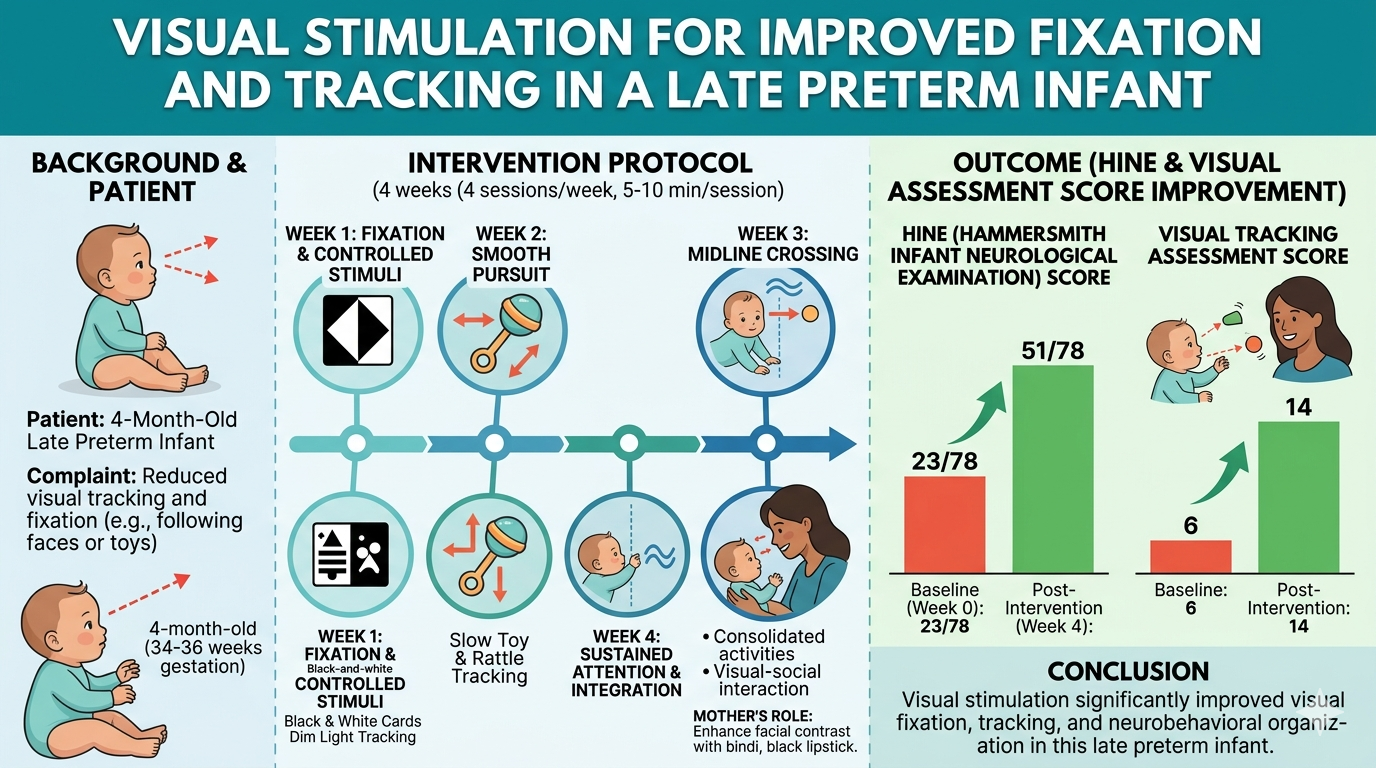
Case description and management: A 4-month-old child was brought by the parent with complaints of reduced visual tracking and fixation. Clinical findings met ICD-10 criteria for late preterm birth, a disorder related to neurological and sensory system immaturity. The infant received four sessions per week for 4 weeks, each lasting approximately 5–10 minutes. The intervention included black-and-white cards, toy or rattle tracking, dim light tracking, and high-contrast geometric patterns. Baseline assessment using the Hammersmith Infant Neurological Examination (HINE) and the Visual Tracking Assessment revealed reduced neurobehavioral organisation and poor visual tracking, with scores of 23/78 on HINE and 6 on the visual tracking assessment. Following four weeks of visual stimulation intervention, the scores improved to 51/78 on the HINE and 14 on the visual tracking assessment, indicating improved visual fixation, tracking, and neurobehavioral response.
Conclusion: This case demonstrates that visual stimulation can effectively enhance visual fixation and tracking in preterm newborns, thereby improving overall well-being.
Downloads
12
5 PDF
4 Review report
4
References
Sundaram VA, Chandrababu P, Balamurugan BS, Saravanan B, Marimuthu MMC, Sundaram T, Anbalagan S, Arora S, Chopra H. Impact of maternal endocrine health on foetal development and pregnancy outcomes. Scripta Medica. 2025 Oct 31;56(5):965-985. doi: https://10.5937/scriptamed56-56919
Jeivanth SB, Baskar S, Fareed M, Kumar KS, Mostafa OE, Bawazir A, AlQumaizi KI. Role of hematological parameters in the early detection of clinical cases for septicemia among neonates: A hospital-based study from Chennai, India. PLoS One. 2025 Mar 19;20(3):e0318802. doi: https://doi.org/10.1371/journal.pone.0318802
Jawahar A, Maragathavalli G. Assessment of oral health and treatment needs in population with visual impairment. J Indian Acad Oral Med Radiol. 2022;34(1):60–67. doi: https://doi.org/10.4103/jiaomr.jiaomr_240_21
Mohammed AAF, Kambam KK, Thirumalai J, Ramalingam V, Kamalakannan SK. Effectiveness of Preterm Infant Oral Motor Intervention (PIOMI) with Kangaroo Mother Care (KMC) among Preterm Neonates. International Research Journal of Multidisciplinary Scope. 2026 Jan 21; 7(1): 727-737. doi: https://10.47857/irjms.2026.v07i01.07424
Moran CA, Costa VSLP, Marx LO, Fernandes Costa M. Visual stimulation in the neonatal intensive care unit: A systematic literature review. J Child Health Care. 2025 Sep;29(3):684-697. doi: https://doi.org/10.1177/13674935241227344
Necula AI, Stoiciu R, Radulescu Botica R, Durdu CE, Bohiltea R. Neurological Outcomes in Late Preterm Infants: An Updated Review of Recent Research and Clinical Insights. Diagnostics (Basel). 2025 Jun 14;15(12):1514. doi: https://doi.org/10.3390/diagnostics15121514
Fagundes RBB, Silva PYF, Barboni MTS, da Fonseca Filho GG, Almeida VA, Azevedo IG, Pereira SA. Visual Acuity Thresholds in Preterm Newborns: An Experimental Study. Children (Basel). 2024 Aug 28;11(9):1049. doi: https://doi.org/10.3390/children11091049
Thirumalai J, Sekar M, Ramalingam V, Bhuvaneshwar S, Gajendran K, Jeslin GN. Culturally Adapted Play-based Behavioral Intervention among Children with Autism Spectrum Disorder in Semi-rural Tamil Nadu: A Randomized Controlled Trial. Journal of Mental Health and Human Behaviour. 2025 Jul 1;30(2):90-97. doi: https://10.4103/jmhhb.jmhhb_50_25
Fontana C, De Carli A, Ricci D, Dessimone F, Passera S, Pesenti N, Bonzini M, Bassi L, Squarcina L, Cinnante C, Mosca F, Fumagalli M. Effects of Early Intervention on Visual Function in Preterm Infants: A Randomized Controlled Trial. Front Pediatr. 2020 Jun 4;8:291. doi: https://doi.org/10.3389/fped.2020.00291
Burstein O, Zevin Z, Geva R. Preterm Birth and the Development of Visual Attention During the First 2 Years of Life: A Systematic Review and Meta-analysis. JAMA Netw Open. 2021 Mar 1;4(3):e213687. doi: https://doi.org/10.1001/jamanetworkopen.2021.3687
Downloads
Published
How to Cite
Issue
Section
License
Copyright (c) 2026 Anees Ahmed Farooq Mohammed, Deepika Dhanacheziyan, Vignesh Srinivasan, Keren Christiana Dominic Savio

This work is licensed under a Creative Commons Attribution-NonCommercial 4.0 International License.


