Ethylmethylhydroxypyridine succinate, acetylcysteine and choline alphoscerate improve mitochondrial function under condition of cerebral ischemia in rat
Abstract
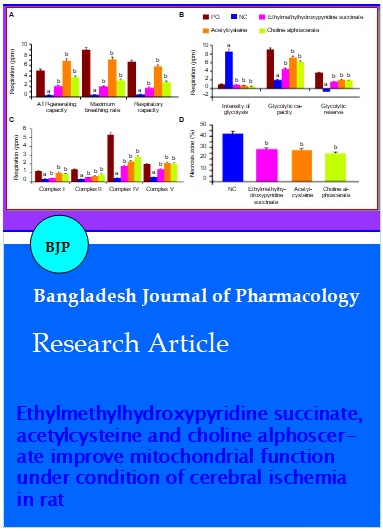
The study was devoted to see the effect of ethylmethylhydroxypyridine succinate, acetylcysteine and choline alphoscerate on the mitochondrial function under condition of experimental cerebral ischemia in rat. An integrated approach was used with the assessment of changes in the respirometric and antiapoptotic functions of mitochondria. It was found that the application of the objects under study contributed to a decrease in the intensity of glycolysis and the restoration of aerobic glucose metabolism with an increase in ATP synthesis, as well as a decrease in the dissociation of reactions in mitochondrial complexes I, II, IV and V. In addition, the introduction of the studied drugs reduced the intensity of caspase-dependent and caspase-independent apoptosis reactions, which, together with the restoration of mitochondrial respiratory function, contributed to the decrease in the size of the necrosis zone of the brain.
Video Clip of Methodology:
Rat middle cerebral artery occlusion: 8 min 7 sec Full Screen Alternate
Downloads
218
171 Read
4
References
Balashov VP, Smirnov LD, Balykova LA, Gerasimova NG., Markelova IA, Kruglyakov PP, Talanova EV. Investigation of the role of the inducible isoform of NO synthase in the stress-protective activity of the ethylmethylhydroxypyridine succinate antioxidant. Russ J Cardiol. 2007; 2: 95-97.
Bederson JB, Pitts LH, Tsuji M, Nishimura MC, Davis RL, Bartkowski H. Rat middle cerebral artery occlusion: Evaluation of the model and development of a neurologic examination. Stroke 1986; 17: 472-76.
Colucci L, Bosco M, Rosario Ziello A, Rea R, Amenta F, Fasanaro AM. Effectiveness of nootropic drugs with cholinergic activity in treatment of cognitive deficit: A review. J Exp Pharmacol. 2012; 4: 163-72.
Di Meo S, Reed TT, Venditti P, Victor VM. Role of ROS and RNS sources in physiological and pathological conditions. Oxid Med Cell Longev. 2016; 2016.
Ham PB 3rd, Raju R. Mitochondrial function in hypoxic ischemic injury and influence of aging. Prog Neurobiol. 2017; 157: 92-116.
Khoshnam SE, Winlow W, Farbood Y, Moghaddam HF, Farzaneh M. Emerging roles of microRNAs in ischemic stroke: As possible therapeutic agents. J Stroke. 2017; 19: 166-87.
Kim JH, Lee Y. Dementia and death after stroke in older adults during a 10-year follow-up: Results from a competing risk model. J Nutr Health Aging. 2018; 22: 297-301.
Kumar R, Bukowski MJ, Wider JM, Reynolds CA, Calo L, Lepore B, Tousignant R, Jones M, Przyklenk K, Sanderson TH. Mitochondrial dynamics following global cerebral ischemia. Mol Cell Neurosci. 2016; 76: 68-75.
Leist M, Single B, Castoldi AF, Kühnle S, Nicotera P. Intra-cellular adenosine triphosphate (ATP) concentration: A switch in the decision between apoptosis and necrosis. J Exp Med. 1997; 185: 1481-86.
Li L, Peng L, Zuo Z. Isoflurane preconditioning increases B-cell lymphoma-2 expression and reduces cytochrome c release from the mitochondria in the ischemic penumbra of rat brain. Eur J Pharmacol. 2008; 586: 106-13.
Milasta S, Dillon CP, Sturm OE, Verbist KC, Brewer TL, Quarato G, Brown SA, Frase S, Janke LJ, Perry SS, Thomas PG, Green DR. Apoptosis-inducing-factor-dependent mitochondrial function is required for T cell but not B cell function. Immunity 2016; 44: 88-102.
Natarajan SK, Becker DF. Role of apoptosis-inducing factor, proline dehydrogenase, and NADPH oxidase in apoptosis and oxidative stress. Cell Health Cytoskelet. 2012; 2012: 11-27.
Patel SP, Sullivan PG, Pandya JD, Goldstein GA, VanRooyen JL, Yonutas HM, Eldahan KC, Morehouse J, Magnuson DS, Rabchevsky AG. N-acetylcysteine amide preserves mitochondrial bioenergetics and improves functional recovery following spinal trauma. Exp Neurol. 2014; 257: 95-105.
Pei Y, Liu H, Yang Y, Yang Y, Jiao Y, Tay FR, Chen J. Biological activities and potential oral applications of N-acetylcysteine: Progress and prospects. Oxid Med Cell Longev. 2018; 2018.
Sauerbeck A, Pandya J, Singh I, Bittman K, Readnower R, Bing G, Sullivan P. Analysis of regional brain mitochondrial bioenergetics and susceptibility to mitochondrial inhibition utilizing a microplate based system. J Neurosci Methods. 2011; 198: 36-43.
Sidorenko GI, Komissarova SM, Zolotukhina SF, Petrovskaya ME. The use of ethylmethylhydroxypyridine succinate in the treatment of patients with heart failure. Kardiologiia 2011; 51: 44-48.
Strifler G, Tuboly E, Görbe A, Boros M, Pécz D, Hartmann P. Targeting mitochondrial dysfunction with L-alpha glyceryl-phosphorylcholine. PLoS One. 2016; 11: e0166682.
Sullivan PG, Krishnamurthy S, Patel SP, Pandya JD, Rabchevsky AG. Temporal characterization of mitochondrial bio-energetics after spinal cord injury. J Neurotrauma. 2007; 24: 991-99.
Tardiolo G, Bramanti P, Mazzon E. Overview on the effects of N-acetylcysteine in neurodegenerative disease. Molecules 2018; 23: E3305.
Tayebati SK, Martinelli I, Moruzzi M, Amenta F, Tomassoni D. Choline and choline alphoscerate do not modulate inflammatory processes in the rat brain. Nutrients 2017; 9: 1084.
Voronkov AV, Pozdnyakov DI. Endothelotropic activity of 4-hydroxy-3,5-di-tret-butylcinnamic acid in the conditions of experimental cerebral ischemia. Res Result Pharm. 2018; 2: 1-10.
Yang JL, Mukda S, Chen SD. Diverse roles of mitochondria in ischemic stroke. Redox Biol. 2018; 16: 263-75.
Yasnetsov VV, Prosvirova EP. Investigation of the effect of mexidol and cytoflavine on respiration of rat brain mitochondria. Bull New Med Tech. 2012; 19: 101-02.
Copyright (c) 2019 Pozdnyakov I. Dmitry, Nygaryan A. Syranusch, Voronkov V. Andrey, Anastasya Sosnovskaya, Cherechkova I. Elisaveta

This work is licensed under a Creative Commons Attribution 4.0 International License.
Authors who publish with this journal agree to the following terms:
- Authors retain copyright and grant the journal right of first publication with the work simultaneously licensed under a Creative Commons Attribution License that allows others to share the work with an acknowledgement of the work's authorship and initial publication in this journal.
- Authors are able to enter into separate, additional contractual arrangements for the non-exclusive distribution of the journal's published version of the work (e.g., post it to an institutional repository or publish it in a book), with an acknowledgement of its initial publication in this journal.
- Authors are permitted and encouraged to post their work online (e.g., in institutional repositories or on their website) prior to and during the submission process, as it can lead to productive exchanges, as well as earlier and greater citation of published work (See The Effect of Open Access).