About the Journal
Aims and Scope
The Asian-Australasian Journal of Bioscience and Biotechnology (AAJBB) is an official publication of Ebu Press Ltd, committed to advancing and disseminating the latest knowledge and innovation in bioscience and biotechnology. As an open-access, peer-reviewed international journal, AAJBB provides a platform for scientists, academicians, and professionals to publish high-quality research that bridges the gap between basic and applied biological sciences. The journal encourages to submit editorial, comprehensive reviews, original full-length research, short communications, and case reports that address global challenges in health, agriculture, environment, and industry through innovative biotechnological approaches. By fostering interdisciplinary collaboration and scientific communication, AAJBB aims to contribute significantly to the progress of modern bioscience and biotechnology across Asia and the world. The aims and scope of the journal is very wide, but is not limited to, the following areas,
Agricultural Biotechnology: Research focusing on the use of modern biotechnology to improve crop yield, pest resistance, and stress tolerance. Studies exploring genetic modification, molecular breeding, and precision agriculture for sustainable food production are encouraged.
Environmental Biotechnology: Research addressing biotechnological solutions for pollution control, bioremediation, and waste management. Studies exploring microbial and enzymatic processes to mitigate environmental contamination are emphasized.
Animal Biotechnology: Studies exploring advancements in animal genetics, reproduction, and disease resistance. Research highlighting molecular breeding, transgenic animal production, and livestock improvement is welcomed.
Aquatic Biology and Fisheries Science: Research focusing on aquatic biodiversity, fish physiology, and aquaculture development. Studies addressing sustainable fish production, disease management, and aquatic ecosystem conservation are included.
Zoology and Wildlife Biology: Studies exploring animal behavior, taxonomy, and ecological adaptation. Research addressing conservation strategies and wildlife population genetics is appreciated.
Food Science and Technology: Research highlighting food processing, quality control, and preservation methods. Studies exploring nutritional enhancement, food safety, and functional food development are prioritized.
Marine Bioscience: Studies addressing the biological diversity of marine ecosystems and their biotechnological potential. Research exploring marine natural products, marine microbiology, and bioprospecting of marine organisms is encouraged.
Cellular and Molecular Biology: Research focusing on cellular signaling, gene expression, and molecular mechanisms underlying life processes. Studies exploring molecular interactions, cell cycle regulation, and structural biology are included.
Developmental Biology: Studies addressing embryonic development, differentiation, and morphogenesis. Research exploring genetic and epigenetic control of developmental processes is emphasized.
Immunology and Microbiology: Research highlighting immune mechanisms, host-pathogen interactions, and infectious disease biology. Studies exploring antimicrobial resistance, immunotherapy, and vaccine development are encouraged.
Applied Biochemistry: Studies addressing enzymology, metabolism, and biochemical pathways in living organisms. Research exploring enzyme kinetics, protein modifications, and metabolomics is valued.
Biomedical Sciences: Research focusing on human health, diagnostics, and therapeutic innovations. Studies exploring biomedical devices, regenerative medicine, and molecular diagnostics are emphasized
Genetics and Genomics: Research highlighting genetic mapping, genome sequencing, and population genetics. Studies exploring genetic diversity, gene function, and evolutionary relationships are welcomed.
Genetic Engineering and Synthetic Biology: Studies exploring recombinant DNA technology, CRISPR-Cas systems, and metabolic engineering. Research addressing the design and synthesis of novel biological systems is encouraged.
Bioinformatics and Computational Biology: Research focusing on computational modeling, data analysis, and algorithmic approaches to biological problems. Studies exploring genomics, proteomics, and systems biology applications are featured.
Enzyme Engineering: Studies addressing enzyme design, catalytic mechanisms, and industrial applications. Research highlighting protein engineering and directed evolution for enhanced enzyme performance is promoted.
Protein Science and Structural Biology: Research exploring protein folding, structure–function relationships, and molecular dynamics. Studies addressing structural elucidation through crystallography or spectroscopy are encouraged.
Nanobiotechnology: Studies exploring nanoscale materials for biomedical, agricultural, and environmental applications. Research highlighting nanoparticle synthesis, biosensing, and targeted drug delivery systems is encouraged.
Ecology and Ecotoxicology: Research addressing interactions among organisms and their environments under anthropogenic stress. Studies exploring the toxic effects of pollutants and ecological risk assessment are emphasized.
Biostatistics and Quantitative Biology: Studies addressing statistical modeling, data analysis, and hypothesis testing in biological sciences. Research exploring advanced statistical tools and their applications in experimental biology is supported.
Biophysics: Research highlighting the physical principles underlying biological systems. Studies exploring biomolecular interactions, thermodynamics, and mechanobiology are encouraged.
Industrial Biotechnology: Studies exploring bioprocess optimization, fermentation technology, and bio-based production systems. Research addressing biorefineries, biofuels, and green industrial applications is emphasized.
Plant Science and Physiology: Research focusing on plant metabolism, stress responses, and genetic improvement. Studies exploring molecular plant–microbe interactions and physiological adaptations are encouraged.
Reproductive Biology: Studies addressing reproductive physiology, fertility regulation, and developmental genetics. Research highlighting reproductive technologies in humans and animals is appreciated.
Molecular Medicine: Research exploring disease mechanisms at the molecular level. Studies addressing biomarker discovery, targeted therapy, and personalized medicine are prioritized.
Neuroscience and Neurobiology: Studies exploring brain function, neural development, and neurodegenerative diseases. Research highlighting neurophysiology and molecular neuroscience is featured.
Parasitology: Research addressing parasite biology, epidemiology, and host–parasite interactions. Studies exploring molecular diagnostics and control strategies for parasitic diseases are encouraged.
Pharmaceutical Biotechnology: Studies exploring drug discovery, vaccine formulation, and therapeutic proteins. Research highlighting pharmacogenomics and delivery systems is emphasized.
Agricultural Microbiology: Research focusing on plant–microbe interactions, biofertilizers, and soil health. Studies addressing microbial applications in sustainable agriculture are encouraged.
Environmental Microbiology: Studies exploring microbial ecology in natural and polluted environments. Research highlighting bioremediation and microbial community dynamics is valued.
Evolutionary Biology: Research addressing genetic variation, adaptation, and speciation processes. Studies exploring molecular evolution and phylogenetic analysis are emphasized.
Systems Biology: Studies exploring integrative models of biological networks and metabolic pathways. Research highlighting computational simulation of complex biological systems is appreciated.
Toxicology: Research addressing the effects of environmental and industrial chemicals on biological systems. Studies exploring mechanisms of toxicity, detoxification, and risk assessment are encouraged.
Bioethics and Biosafety: Studies exploring ethical, social, and regulatory issues in biotechnology research. Research highlighting biosafety guidelines, responsible conduct, and policy frameworks is welcomed.
Types of articles
AAJBB publishes the following categories of manuscripts to accommodate diverse scholarly contributions and promote rigorous scientific communication,
- Editorials: Concise scholarly articles providing expert perspectives, critical commentary, or informed opinions on emerging issues, policy developments, or recently published research within the journal’s scope.
- Comprehensive review articles: In-depth and critical syntheses of existing literature that summarize recent advances, identify research gaps, evaluate current challenges, and propose future research directions.
- Original full-length research articles: Detailed reports of novel and scientifically rigorous research findings derived from experimental, clinical, field-based, or analytical studies that contribute substantial new knowledge to the discipline.
- Short communications: Brief reports of original research findings that are preliminary, narrowly focused, or based on limited datasets but demonstrate clear scientific relevance and novelty.
- Case reports: Structured analyses of specific clinical cases, experimental observations, or unique field situations that provide practical insights, highlight uncommon findings, and contribute to scientific understanding or professional practice.
Open Access Policy
The Asian-Australasian Journal of Bioscience and Biotechnology adheres to the I4OC standard for open citations, ensuring that all content is accessible to users or institutions free of charge. Users are allowed to read, download, copy, distribute, print, search, or link to the full texts of the articles in this journal without asking prior permission from the publisher or the author. This is in accordance with the BOAI (Budapest Open Access Initiative) definition of open access.
All articles published by the Asian-Australasian Journal of Bioscience and Biotechnology are made freely and permanently accessible online without delay. The full text of all content is available for free and open access immediately upon publication, with no embargo period. There is also no requirement for users to register in order to read content. Articles are posted online as soon as they are ready for publication, ensuring rapid dissemination of research findings.
Each article is assigned a unique Crossref DOI (Digital Object Identifier), making it instantly searchable and citable. The articles are open access and licensed under the terms of the Creative Commons Attribution 4.0 International License (CC BY 4.0), which permits unrestricted use, distribution, and reproduction in any medium, provided the original work is properly cited.
Digital Preservation
Asian-Australasian Journal of Bioscience and Biotechnology is registered in Open Policy Finder (formerly known as Sherpa Romeo), which is an online resource that aggregates and presents publisher and journal open access policies from around the world. The articles in Asian-Australasian Journal of Bioscience and Biotechnology are deposited as Crossref metadata which are preserved by the CLOCKSS (Controlled Lots of Copies Keep Stuff Safe) system.
Editorial Process
The AAJBB is committed to upholding the highest standards of content quality and ethical integrity through a meticulous editorial process. The journal adheres to a well-defined editorial workflow, as illustrated in the accompanying flow chart, to ensure these standards are met.
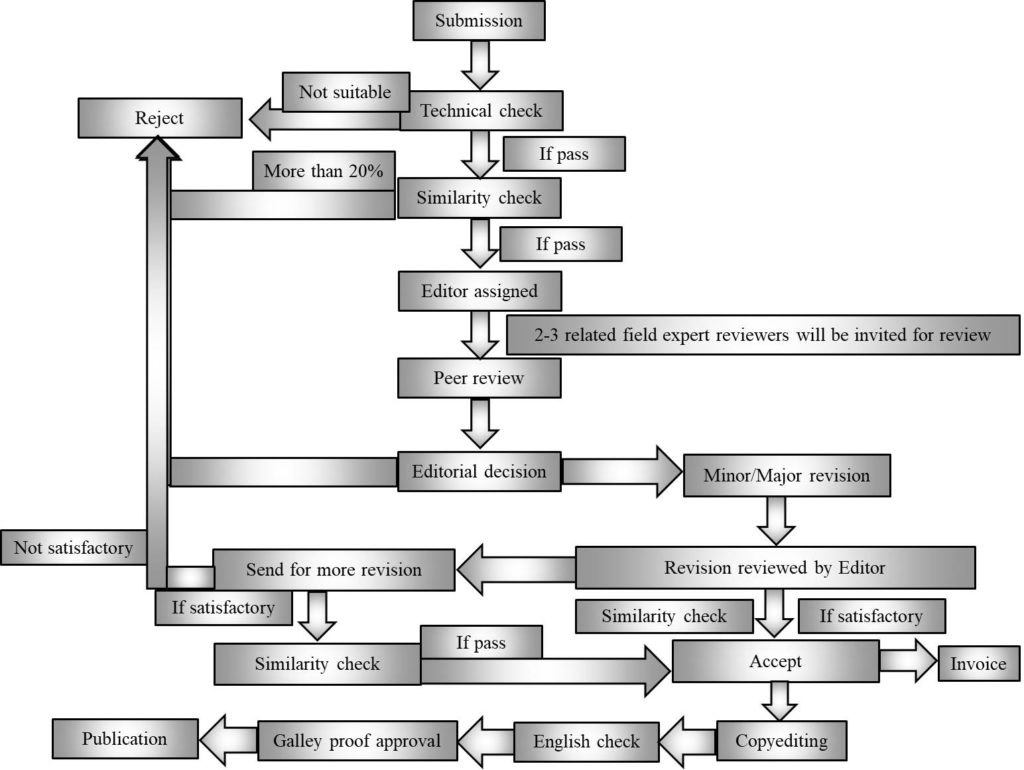
The editorial process for the AAJBB typically involves the following stages-
Submission of the manuscript: The process begins when authors submit their research manuscripts to AAJBB for potential publication. Authors are required to follow the journal’s submission guidelines, which typically include manuscript structure, reference format, and file type.
Technical check: Upon manuscript submission, it undergoes a technical check. This step ensures that the manuscript complies with AAJBB’s specific formatting and submission requirements. It includes evaluating the manuscript’s structure, adherence to reference formatting, and compatibility with the required file format.
Similarity check: To maintain academic integrity and ethical publishing standards, a similarity check is performed on the submitted manuscript. Specialized software, such as iThenticate/Turnitin, may be employed to identify any instances of plagiarism or excessive similarity to previously published works.
Editor assigned: Once the manuscript passes the initial checks, it is assigned to an editor with expertise in the relevant field. The editor’s role is to oversee the review process, facilitate communication between authors and reviewers, and make editorial decisions based on peer review feedback.
Peer review: The assigned editor selects peer reviewers who are experts in the field of submitted manuscript. These reviewers evaluate the manuscript’s quality, methodology, significance, and validity. They provide detailed comments and recommendations to the editor (for more details, please refer to the review policy).
Editorial decision: Following the peer review process, the editor makes a decision regarding the manuscript. This decision can result in several outcomes:
- Acceptance: If the manuscript is deemed suitable for publication without further revisions, it is accepted.
- Minor revision: Authors are asked to make minor changes or revisions to address specific issues or suggestions from peer reviewers.
- Major revision: Authors are required to make significant changes, which may involve conducting additional experiments or analyses to strengthen the manuscript.
- Rejection: Manuscripts that do not meet the journal’s quality standards or the recommendations of peer reviewers may be rejected.
Minor/major revision: If revisions are requested, authors receive feedback and guidance from peer reviewers and the editor. Authors are expected to address these comments and suggestions in their revised manuscript.
Revision reviewed by editor: After authors make revisions, the editor reviews the revised manuscript to ensure that all suggested changes have been adequately addressed. The editor plays a pivotal role in the final decision-making process.
Rejection after revision: Manuscripts that fail to meet the journal’s quality standards or do not adequately address the reviewers’ concerns may be rejected at this stage.
Send for more revision: If the revisions remain incomplete or unsatisfactory, authors may be asked to make further revisions until the manuscript aligns with the journal’s standards and reviewers’ expectations.
Similarity check for revised manuscript: To verify that any potential issues of plagiarism or excessive similarity have been resolved in the revised manuscript, a similarity check may be repeated.
Accepted: Once the manuscript fully aligns with the journal’s standards and the editor’s satisfaction, it is formally accepted for publication, pending the completion of subsequent steps.
Author invoice: Authors may receive an invoice for publication fees, depending on the journal’s policies. These fees can vary and may cover various publication costs.
Copyediting: The manuscript undergoes a copyediting process to rectify language, grammar, style, and formatting issues. This step ensures that the manuscript is clear, consistent, and adheres to AAJBB’s editorial standards.
English editing: In cases where English is not the author’s native language, additional English editing may be performed to enhance the manuscript’s readability and overall quality.
Galley proof approval: Authors receive a formatted version of the manuscript, often referred to as “galley proof.” They review and approve this final version to check for any remaining errors or issues before publication. This step is crucial to ensure the manuscript’s accuracy and readiness for publication.
Publication: Upon final approval, the manuscript is officially published in AAJBB. It becomes accessible to the scientific community and readers. A DOI (Digital Object Identifier) is typically assigned for reference purposes, and the manuscript is archived within the journal, making it part of its scholarly record.
Plagiarism Policy
The AAJBB is committed to maintaining the highest standards of integrity in scholarly publishing. Plagiarism, in any form, is considered a serious violation of academic and ethical standards. AAJBB has a strict plagiarism policy in place to ensure the originality of the work we publish.
What is plagiarism?
The texts or work submitted to AAJBB will be considered as plagiarized, which includes, but is not limited to, the following:
- Direct copying of text, data, or ideas from another source, including published papers, without proper citation.
- Paraphrasing or rephrasing someone else’s work without proper acknowledgment.
- Self-plagiarism, which includes the reuse of one’s own previously published work without appropriate citation and permission.
- Verbatim or near-verbatim translation of text from another language without appropriate citation.
- Unauthorized use of images, figures, tables, or any intellectual property without proper attribution.
Plagiarism screening with professional tools
All submitted manuscripts to AAJBB are strictly screened for similarity using advanced plagiarism detection software such as Turnitin and/or iThenticate. This process ensures that submitted works are original and free from unethical reproduction of previously published content. This process is implemented both at the initial submission stage and after the revised version is received from the author. The similarity reports generated by these tools are carefully reviewed by the editorial team both at the initial submission stage and after the revised version is received from the author. Manuscripts showing significant overlap with previously published works—without appropriate citation or justification—will be subject to scrutiny, clarification, or outright rejection, depending on the extent of the duplication.
Consequences of plagiarism
Authors are expected to adhere to the highest standards of academic integrity and ethical conduct. If plagiarism or any form of academic misconduct is detected, AAJBB follows a strict protocol,
- Plagiarized content will be highlighted and brought to the authors’ attention for clarification or correction.
- Depending on the extent and severity of the plagiarism, manuscripts may be rejected or returned to authors for revisions.
- In cases of serious or repeated plagiarism, AAJBB may notify the authors’ institutions or funding agencies, and the manuscript may be permanently rejected or retracted post-publication.
- Authors found guilty of plagiarism may be subject to a temporary or permanent ban from submitting to AAJBB and other actions deemed necessary to uphold academic integrity.
- In case of plagiarism detected after publication of the article, the article can be retracted (please see AAJBB’s correction and retraction policy).
Preventing plagiarism
Authors submitting to AAJBB are encouraged to take the following steps to prevent plagiarism:
- Clearly cite and reference all sources used in the manuscript.
- Attribute all quoted or paraphrased content appropriately.
- Seek permission for the use of any copyrighted material.
- Avoid self-plagiarism by properly citing and referencing any prior work that is used in the manuscript.
- Use plagiarism detection software to check the manuscript before submission.
Plagiarism induced by repository deposition of thesis or manuscript
Authors who intend to submit manuscripts or theses to AAJBB that have been previously deposited in institutional, preprint, or other repositories must adhere to the following guidelines to prevent repository-induced plagiarism:
- Citation and attribution: Authors must provide proper citation and attribution to the repository where the manuscript or thesis was initially deposited. The name of the repository and the DOI (Digital Object Identifier), if available, must be clearly mentioned.
- Originality and copyright: Authors are responsible for ensuring that the material deposited in repositories, including manuscripts or theses, is their original work or complies with copyright and licensing agreements. If any part of the deposited material is not their own work, appropriate permission must be obtained and cited.
- Paraphrasing and attribution: In cases where authors reuse portions of text or content from their previously deposited work, they must rephrase or paraphrase the content and provide clear attribution to the original repository deposit.
- Submission clarification: During the manuscript submission process, authors must clearly state in the cover letter, if the manuscript or thesis has been deposited in a repository. This information is vital for transparent and ethical review.
Review Policy
The Asian-Australasian Journal of Bioscience and Biotechnology (AAJBB) is committed to maintaining the highest standards of scientific integrity, transparency, and academic excellence. All submitted manuscripts undergo a rigorous, structured, and unbiased peer-review process to ensure the publication of high-quality and ethically sound research. The review system is designed to evaluate the originality, methodological rigor, clarity, scientific contribution, and relevance of each submission within the journal’s scope.
Initial editorial assessment
Upon submission, each manuscript undergoes a preliminary evaluation by the editorial office to ensure,
- Compliance with the journal’s aims and scope
- Adherence to formatting and submission guidelines
- Ethical approval statements (where applicable)
- Disclosure of conflicts of interest
- Completeness of required documents
- Similarity/plagiarism screening
Manuscripts that do not meet these requirements may be returned to the authors for correction or rejected prior to peer review.
Peer-review model
AAJBB follows a single-blind peer-review system, in which,
- Reviewers are aware of the authors’ identities.
- Authors do not know the identities of the reviewers.
All research manuscripts are evaluated by at least two independent experts with appropriate subject expertise. Reviewers are selected based on their academic qualifications, research experience, and publication record in the relevant field. The peer-review process focuses on,
- Scientific originality and novelty
- Methodological soundness and statistical validity
- Clarity of objectives and research questions
- Ethical compliance
- Accuracy of data interpretation
- Relevance and contribution to the discipline
- Quality of writing and presentation
Reviewer reports are treated as strictly confidential and will not be disclosed without explicit permission.
Reviewer invitation and responsibilities
- Invited reviewers are given 21 days to complete their evaluation.
- If a review is not submitted within the specified period, it is considered overdue.
- If a reviewer fails to respond to reminder communications, the invitation will be withdrawn and reassigned to another qualified reviewer to avoid unnecessary delays.
Reviewers are expected to provide constructive, unbiased, and evidence-based comments that assist both the editors in decision-making and the authors in improving their manuscripts.
Editorial decision and author revision
After receiving reviewer comments,
- The Editor evaluates the reports for clarity, consistency, and relevance.
- A decision (minor revision, major revision, acceptance, or rejection) is communicated to the corresponding author along with consolidated reviewer comments.
Authors are required to:
- Submit a revised manuscript addressing all reviewer and editorial comments.
- Provide a detailed response-to-reviewers document explaining how each comment has been addressed.
- Complete the revision within three (3) weeks of receiving the decision letter.
Failure to submit the revised manuscript within the specified timeframe will result in the manuscript being considered rejected, and its submission record may be removed from the journal system.
Where necessary, revised manuscripts may be returned to the original reviewers for further evaluation to ensure that concerns have been adequately addressed.
Final decision authority
The final decision regarding publication rests with the Editor-in-Chief or a designated member of the Editorial Board. Decisions are based on,
- Reviewer recommendations
- Scientific merit and originality
- Relevance to the journal’s scope
- Compliance with ethical and publication standards
- The editorial decision is final.
Review timeline
Under normal circumstances, if the review and revision processes proceed smoothly, a final decision (acceptance or rejection) is typically reached within 6-8 weeks from the date of complete submission. However, the timeline may vary depending on reviewer availability, the extent of revisions required, and the responsiveness of authors.
Commitment to ethical standards
AAJBB upholds strict ethical standards in accordance with internationally recognized publishing guidelines. The journal does not tolerate plagiarism, data fabrication, data falsification, duplicate submission, or unethical research practices. Any ethical concerns identified during review may result in rejection or further investigation.
Membership
Asian-Australasian Journal of Bioscience and Biotechnology is a member of the Committee on Publication Ethics (COPE).
Copyright Policy
All articles published in Asian-Australasian Journal of Bioscience and Biotechnology (AAJBB) are open access and freely available online worldwide. AAJBB supports authors retaining copyright while allowing broad dissemination and responsible reuse of published research.
Copyright ownership
Authors retain copyright of their articles. Publication in AAJBB does not require authors to transfer copyright ownership to the journal or publisher. Authors grant AAJBB the necessary non-exclusive rights to publish, distribute, archive, preserve, and make their articles publicly available.
Creative commons license
All newly published articles are licensed under the Creative Commons Attribution 4.0 International License (CC BY 4.0). This license permits anyone to use, share, copy, reproduce, distribute, adapt, and build upon the published work, including for commercial purposes, provided that appropriate credit is given to the original author(s) and source.
Attribution and responsible reuse
Any reuse of an AAJBB article must properly acknowledge the author(s), article title, journal, and original publication, preferably with the DOI or permanent link. Users should indicate whether changes have been made and must not imply endorsement by the authors, AAJBB, or the publisher.
Intellectual property rights
AAJBB respects the intellectual property rights of authors, institutions, funders, research participants, collaborators, and third parties. Authors are responsible for ensuring that they have the necessary rights and permissions to submit and publish their work, including data, figures, photographs, tables, questionnaires, research instruments, software, and other protected materials.
Third-party materials
Authors must obtain appropriate permission for copyrighted or otherwise protected third-party material where permission is required. Such material must be properly acknowledged. Publication under CC BY 4.0 does not automatically place third-party content included in an article under the same license.
Research data and intellectual property
Authors retain applicable rights in their research data and other intellectual property, subject to any institutional, funder, contractual, collaborative, privacy, or legal requirements. Authors should clearly identify any restrictions affecting the sharing or reuse of research data, software, materials, or other intellectual property.
Author rights and self-archiving
Authors may share and deposit their published articles in personal, institutional, subject, or other appropriate repositories, subject to applicable licensing and attribution requirements. AAJBB supports the immediate sharing and dissemination of its open-access publications.
Protection of intellectual property and research integrity
Plagiarism, unauthorized reproduction, misappropriation of intellectual property, copyright infringement, and unacknowledged reuse of another person’s work are unacceptable. AAJBB may investigate suspected violations and may take appropriate action, including correction, withdrawal, expression of concern, or retraction, where warranted.
Commercial and educational reuse
CC BY 4.0 permits lawful academic, educational, non-commercial, and commercial reuse without obtaining additional permission from AAJBB, provided that the license terms and attribution requirements are followed. Users remain responsible for obtaining permission for any third-party material not covered by the CC BY license.
Copyright and policy updates
Copyright and intellectual property matters will be handled in accordance with applicable laws, licensing terms, publication-ethics principles, and relevant institutional or funder requirements. AAJBB may periodically review and update this policy to maintain transparent and responsible copyright, licensing, and intellectual property practices.
Self-Archiving Policy
AAJBB’s self-archiving policy is aimed at promoting open access to scientific research and encouraging the dissemination of knowledge. It allows researchers to share their findings more widely and ensures that the work is not locked behind paywalls or restricted access.
The self-archiving policy of AAJBB allows authors to self-archive their research works at any stage of the publication process, including pre-submitted manuscripts, submitted manuscripts, manuscripts under review, accepted manuscripts, and published articles. This policy empowers authors to store their own scholarly work in their respective institutional repositories or non-profit subject-based preprint servers. It is important to note that this self-archiving privilege is extended to authors for non-commercial purposes, in line with our commitment to fostering open access and the wider dissemination of scientific knowledge.
Pre-submitted manuscript
Authors are strongly encouraged to share their pre-submission manuscript on preprint servers or repositories prior to submitting it to AAJBB. This proactive step enables authors to engage with researchers and experts in their specific field, even before the completion of the publication process in AAJBB. This early dissemination can potentially lead to increased citations for the author’s work.
A note in the cover letter during submission should include details about the pre-submitted manuscript, such as the name of the repository where it is deposited and the corresponding DOI number. This information ensures transparency and allows for easy accessibility to the pre-submitted work.
It is the responsibility of the author to communicate with the assigned editor regarding any voluntary comments received from subject experts in the deposited repositories. While AAJBB adheres to its own editorial and review policy, the journal also values and respects rigorous comments provided by subject experts on the deposited manuscript. The ultimate decision on whether to incorporate these voluntary comments into the final review and revision process lies with the assigned editor.
Submitted manuscript
Authors are permitted to archive their manuscripts after submitting them to the journal but prior to the initiation of the peer review process. To ensure transparency and proper documentation, authors are required to send an email to the journal’s editorial office. This email should include details about the repository where the manuscript is archived, along with the corresponding DOI number.
Under review state
Authors are granted permission to archive their manuscripts even while the material is undergoing review by the journal’s editors and reviewers. To uphold transparency and maintain accurate documentation, authors must send an email to the journal’s editorial office. This email should contain pertinent information regarding the repository in which the manuscript is archived, in addition to the associated DOI number.
Accepted manuscripts
After the journal has accepted the manuscript for publication, authors have the liberty to archive the accepted version, typically the final version authored by the author before any formatting or copyediting by the journal. In line with the commitment to transparency and accurate documentation, authors are required to send an email to the journal’s editorial office. This email should include essential details regarding the repository where the manuscript is archived, along with the corresponding DOI number.
Published articles
After the article has been formally published in the journal, authors retain the privilege to archive it. At this juncture, it is crucial to update the DOI associated with the pre-print to the one provided by the journal for the published version. Authors are actively encouraged to disseminate and share the published article through various means, including but not limited to social media platforms (such as Facebook, X.com, LinkedIn), research platforms (like ResearchGate, Academia.edu, SlideShare, Figshare, PublicationsList.org), institutional repositories (on the university website or research platforms), personal websites, and blogs. This approach supports wider dissemination and access to the published research.
Data Sharing and Reproducibility Policy
The Asian-Australasian Journal of Bioscience and Biotechnology (AAJBB) is committed to promoting research transparency, integrity, responsible data sharing, and reproducibility. The journal follows recognized publication-ethics principles, including relevant guidance from the Committee on Publication Ethics (COPE).
Data sharing
AAJBB encourages authors to make the data supporting their research available whenever ethically, legally, and practically possible. Depending on the nature of the research, shared materials may include raw or processed datasets, anonymized participant data, experimental data, survey or questionnaire data, research protocols, statistical files, analytical files, computer code, software, research materials, figures, tables, and supplementary information. Data may be shared through recognized public or disciplinary repositories, institutional repositories, supplementary files, controlled-access repositories, or by the corresponding author upon reasonable request.
Data availability statement
Authors should provide a clear Data Availability Statement indicating how the supporting data can be accessed. The statement should specify whether data are publicly available in a repository, included with the article or supplementary materials, available upon reasonable request, available through controlled access, or unavailable because of legitimate ethical, legal, privacy, confidentiality, contractual, security, or intellectual property restrictions. Where no research data were generated or analyzed, authors should state this clearly.
Reproducibility and research materials
Authors should provide sufficient information about research design, sampling, data collection, measurements, experimental or laboratory procedures, data processing, statistical analysis, software, and other relevant methods to enable qualified researchers to understand and, where reasonably possible, reproduce the research. Where appropriate and legally permissible, authors are encouraged to provide datasets, protocols, questionnaires, research instruments, statistical files, analytical code, computer scripts, software information, and other supporting materials.
Confidential and sensitive data
AAJBB recognizes that medical and biological research may involve personal, confidential, sensitive, or otherwise restricted information. Authors must protect participant privacy and comply with informed-consent requirements, research-ethics approvals, applicable data-protection laws, confidentiality obligations, and institutional requirements. Where public sharing is inappropriate, authors should use appropriate anonymization or de-identification, controlled-access repositories, secure data environments, data-use agreements, or other suitable safeguards. Restrictions on access should be clearly explained in the Data Availability Statement.
Data repositories, preservation, and citation
Authors are encouraged to deposit research data in reliable repositories that provide stable access, appropriate metadata, long-term preservation, and persistent identifiers such as DOIs. Where appropriate, discipline-specific repositories should be preferred. Datasets and other research resources that materially support an article should be properly cited and attributed. Authors should retain relevant underlying research data and supporting materials for an appropriate period consistent with institutional, funder, ethical, legal, and disciplinary requirements.
Reporting guidelines and study registration
Authors should follow recognized reporting guidelines appropriate to their study design and are encouraged to use relevant guidelines recommended by the EQUATOR Network. Depending on the research, this may include standards for randomized controlled trials, observational studies, systematic reviews and meta-analyses, diagnostic studies, case reports, qualitative research, animal research, and other relevant study types. Where applicable, clinical trials, systematic reviews, research protocols, and other studies should be registered in an appropriate public registry, with the registry name, registration number, and relevant link provided in the manuscript.
Data integrity and editorial verification
Authors must ensure that research data and supporting materials are accurate, reliable, and honestly reported. Fabrication, falsification, inappropriate manipulation, selective alteration of results, or misrepresentation of data or data availability is unacceptable. AAJBB may request underlying data, analytical files, protocols, or supporting documentation when reasonably necessary to verify findings, evaluate methodological concerns, or investigate suspected research-integrity issues. Authors are expected to cooperate with legitimate editorial requests, subject to valid confidentiality, privacy, ethical, and legal restrictions.
Supplementary materials and peer review
Authors may provide datasets, additional tables and figures, questionnaires, protocols, statistical outputs, code, scripts, analytical files, and other materials that support the article. Supplementary materials may be assessed by editors or peer reviewers where relevant to the evaluation of the manuscript. Unpublished data and materials provided during peer review must be treated as confidential and must not be disclosed, distributed, or used for unauthorized purposes.
Responsibilities, exceptions, and post-publication issues
Authors are responsible for providing accurate data-availability information, maintaining appropriate research data, obtaining necessary permissions, protecting participant confidentiality, and complying with applicable ethical, legal, institutional, and intellectual property requirements. Editors may assess data statements, request supporting information, seek expert advice, and investigate credible concerns. Users of shared data must respect applicable licenses, data-use conditions, privacy, confidentiality, intellectual property, and attribution requirements. Legitimate restrictions on data sharing will be considered. Where significant post-publication concerns arise, AAJBB may issue a correction, erratum, corrigendum, expression of concern, or retraction, as appropriate.
Policy compliance and review
Data availability and reproducibility may be considered during editorial assessment where relevant to the research. Authors must not falsely claim that data or materials are available when they are not. AAJBB will handle data-related concerns in accordance with its publication-ethics and research-integrity procedures. This policy will be periodically reviewed and updated to remain consistent with COPE guidance, recognized research-integrity principles, applicable ethical and legal requirements, and evolving standards for responsible data sharing and reproducible research.
Artificial Intelligence Policy
The Asian-Australasian Journal of Bioscience and Biotechnology (AAJBB) recognizes the growing use of artificial intelligence (AI) and generative AI tools in research, manuscript preparation, peer review, and scholarly publishing. This policy establishes responsible, transparent, and ethical use of AI.
Use of AI by authors
Authors may use AI tools to assist with activities such as language improvement, grammar correction, formatting, translation, literature organization, coding, data analysis, or other appropriate research-support tasks. AI tools must not replace the authors’ scientific judgment, critical analysis, or responsibility for the work.
Disclosure of generative AI use
Authors must disclose the use of generative AI tools when such use materially contributes to the manuscript, including generating, analyzing, interpreting, or substantially modifying content. The disclosure should identify the tool used and describe its purpose. Routine spelling, grammar, and formatting assistance generally does not require disclosure.
Author responsibility
Authors remain fully responsible for the accuracy, originality, integrity, and ethical compliance of their manuscript, including all content produced or modified with AI assistance. Authors must verify AI-generated information, references, quotations, data interpretations, and other outputs before submission.
AI as an author
AI tools and systems cannot be listed as authors, co-authors, or contributors. Authorship requires human accountability for the research and manuscript. Any AI-assisted contribution must therefore remain under the responsibility of the human authors.
AI-generated data, images, and content
Authors must clearly identify and disclose the use of AI to generate or substantially modify images, figures, data, text, code, or other research materials where such use could affect the interpretation or integrity of the work. AI must not be used to fabricate, manipulate, falsify, or deceptively alter research data or results.
AI and research integrity
The use of AI must not result in plagiarism, fabrication, falsification, misleading attribution, inappropriate text manipulation, fabricated references, or other violations of research ethics. AAJBB may investigate suspected inappropriate or undisclosed AI use in accordance with its research-integrity procedures.
AI use in peer review and editorial work
Reviewers and editors must not upload or disclose unpublished manuscripts, confidential reviewer reports, personal information, or other protected materials to public or unauthorized AI systems. AI-generated assessments must not replace independent editorial or peer-review judgment. Reviewers and editors remain responsible for the confidentiality, fairness, and accuracy of their evaluations.
Confidentiality and data protection
Authors, reviewers, and editors must ensure that AI tools do not compromise confidential, personal, sensitive, proprietary, or legally protected information. Appropriate safeguards must be applied when AI is used in connection with research data, manuscripts, patient information, or other restricted materials.
Editorial verification and use of AI detection
AAJBB may use appropriate automated or AI-assisted tools to support plagiarism screening, research-integrity checks, image assessment, or identification of potentially undisclosed AI-generated content. Such tools are supplementary and do not replace human editorial assessment. Authors will not be penalized solely on the basis of an automated AI-detection score.
Policy compliance and updates
Failure to disclose material AI use or misuse of AI may result in requests for clarification, manuscript revision, rejection, correction, expression of concern, retraction, or other appropriate action. AAJBB may update this policy as AI technologies, ethical standards, and scholarly publishing practices evolve.
Publication Frequency
This journal annually publishes three issues (April, August, and December) under the continuous publication model, beginning with Volume 7, Issue 2. This means that as soon as an article is ready to be published, it will be immediately assigned to an issue online rather than waiting for other articles to be completed, resulting in faster access to the final version.
Article Processing Charge
All articles featured in the Asian-Australasian Journal of Bioscience and Biotechnology are made available to the public through an open access format. An Article Processing Charge (APC) is imposed on papers that have successfully undergone the peer-review process and have been accepted for publication. The specific APC rates are outlined below for your reference. It is important to note that AAJBB does not levy any charges for manuscript submission, editorial processing, page usage, or color printing. Furthermore, it is imperative to mention that AAJBB does not impose any fees for the withdrawal of manuscripts. Additionally, we provide the opportunity for the publication of errata, corrigenda, addenda, corrections, and retractions at no cost to the authors.
Inland: Authors of Bangladesh will be levied @ BD Tk. 10,000/- per accepted manuscript.
Foreign: Author(s) of manuscripts originating from outside Bangladesh have to pay @ US $ 200 for each accepted article.
Payment Options
1. You can make your payment directly into our bank account (please check invoice) and e-mail the bank wire transfer receipt to us.
2. If you want to make your payment through Western Union, MoneyGram, International Money Express (IME), Xpress Money, Prabhu Money Transfer, TransFast, Merchantrade International Remittance System (MIRS), bKash, or any other means, please write an e-mail to: editor.ebupress.aajbb@gmail.com. We will respond to you with further instructions on how you can pay the APC of an accepted article.
Source of Support
Article processing charges (APCs) received from authors.


