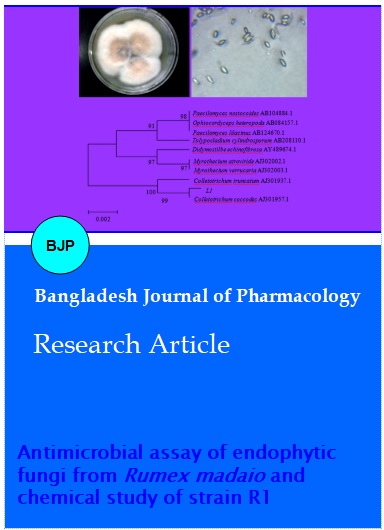
Antimicrobial assay of endophytic fungi from Rumex madaio and chemical study of strain R1
Abstract
In order to search more antimicrobial natural products for new drug discovery, bioassay and chemical investigation of endophytic strains from Rumex madaio were carried out. Six fungal strains (numbered as L1, L6, L9, L10, R1, R2) were successfully isolated and their antimicrobial effects on three human pathogens, Escherichia coli, Staphyloccocus aureus and Candida albicans, were evaluated. The results indicated that ethyl acetate extracts of fermentation broth of these strains had no potent antimicorbial activity against E. coli and C. albicans while strains L1 and R1 had stronger inhibitory effects on S. aureus. On basis of morphological characteristics and 18S rRNA sequence analysis, strains L1 and R1 were respectively classified as Colletotrichum and Fusarium geni. The chemical study of strain R1 led to isolation of two known antimicrobial agents, dibutyl phthalate (1) and beauvericin (2).
Video Clip of Methodology:
1 min 14 sec: Full Screen Alternate
Downloads
416
347 Supplementary File
58 Read
67
References
Akay S, Ekiz G, Kocabas F, Hames-Kocabas EE, Korkmaz KS, Bedir E. A new 5,6-dihydro-2-pyrone derivative from Phomopsis amygdali, an endophytic fungus isolated from hazelnut (Corylus avellana). Phytochem Lett. 2014; 7: 93–96.
de Siqueira KA, Brissow ER, dos Santos JL, White JF, Santos FR, de Almeida EG, Soares MA. Endophytism and bioactivity of endophytic fungi isolated from Combretum lanceolatum Pohl ex Eichler. Symbiosis 2017; 71: 211–22.
de Siqueira VM, Conti R, de Araújo JM, Souza-Motta CM. Endophytic fungi from the medicinal plant Lippia sidoides Cham. and their antimicrobial activity. Symbiosis 2011; 53: 89–95.
Dhankhar S, Dhankhar S, Yadav JP. Investigating antimicrobial properties of endophytic fungi associated with Salvadora oleoides Decne. Anti-Infective Agents. 2013; 11: 49-59
Dzoyem JP, Melong R, Tsamo AT, Maffo T, Kapche DGWF, Ngadjui B, Mcgaw LJ, Eloff JN. Cytotoxicity, antioxidant and antibacterial activity of four compounds produced by an endophytic fungus Epicoccum nigrum, associated with Entada abyssinica. Rev Bras Farmacogn. 2017; 27: 251–253.
Gubiani JR, Habeck TR, Chapla VM, Silva GH, Bolzani VS, Araujo AR. One strain-many compounds (OSMAC) method for production of phenolic compounds using Camarops sp., an endophytic fungus from Alibertia macrophylla (Rubiaceae). Quim Nova. 2016; 39: 1221–1224.
Hemphill CFP, Sureechatchaiyan P, Kassack MU, Orfali RS, Lin WH, Daletos G, Proksch P. OSMAC approach leads to new fusarielin metabolites from Fusarium tricinctum. J Antibiot. 2017; 70: 726–32.
Hewage RT, Aree T, Mahidol C, Ruchirawat S, Kittakoop P. One strain-many compounds (OSMAC) method for production of polyketides, azaphilones, and an isochromanone using the endophytic fungus Dothideomycete sp. Phytochemistry 2014; 108: 87–94.
Hussain H, Root N, Jabeen F, AI-Harrasi F, AI-Rawahi A, Ahmad M, Hassan Z, Abbas G, Mabood F, Shah A, Badshah A, Khan A, Ahmad R, Green IR, Draeger S, Schulz B, Krohn K. Seimatoric acid and colletonoic acid: Two new compounds from the endophytic fungi, Seimatosporium sp. and Colletotrichum sp. Chin Chem Lett. 2014; 25: 1577–79.
Islam R, Abay I. Research progress in Rumex obtusifolius L. Sci Technol Rev. 2013; 31: 67–71.
Kumar S, Nei M, Dudley J, Tamura K. MEGA: A biologist-centric software for evolutionary analysis of DNA and protein sequences. Brief Bioinform. 2008; 9: 299–306.
Li G, Kusari S, Kusari P, Kayser O, Spiteller M. Endophytic Diaporthe sp. LG23 produces a potent antibacterial tetracyclic triterpenoid. J Nat Prod. 2015; 78: 2128–32.
Liu Y, Li Y, Liu Z, Li L, Qu J, Ma S, Chen R, Dai J, Yu S. Sesquiterpenes from the endophyte Glomerella cingulata. J Nat Prod. 2017; 80: 2609–14.
Rajamanikyam M, Vadlapudi V, Parvathaneni SP, Koude D, Sripadi P, Misra S, Amanchy R, Upadhyayula SM. Isolation and characterization of phthalates from Brevibacterium mcbrellneri that cause cytotoxicity and cell cycle arrest. EXCLI J. 2017; 16: 375–387.
Rani R, Sharma D, Chaturvedi M, Yadav JP. Antibacterial activity of twenty different endophytic fungi isolated from Calotropis procera and time kill assay. Clin Microbiol. 2017; 6: 3.
Roy RN, Laskar S, Sen SK. Dibutyl phthalate, the bioactive compound produced by Streptomyces albidoflavus 321.2. Microbiol Res. 2006; 161: 121–26.
Santos SN, Ferraris FK, de Souza AO, das Graças Henriques M, Melo IS. Endophytic fungi from Combretum leprosum, with potential anticancer and antifungal activity. Symbiosis 2012; 58: 109–17.
Tianpanich K, Prachya S, Wiyakrutta S, Mahidol C, Ruchirawat S, Kittakoop P. Radical scavenging and antioxidant activities of isocoumarins and a phthalide from the endophytic fungus Colletotrichum sp. J Nat Prod. 2011; 74: 79–81.
Wang WX, Kusari S, Laatsch H, Golz C, Kusari P, Strohmann C, Kayser O, Spiteller M. Antibacterial azaphilones from an endophytic fungus, Colletotrichum sp. BS4. J Nat Prod. 2016; 79: 704–710.
Wang YJ. Inhibitory activity screening of endophytic fungi from Polygala tenuifolia Willd. Microbiology 2009; 36: 404-11.
Wei JC. Handbook of fungus classification. Shanghai Science and Technology Press, 1979.
Wu J, Liu Z, Su J, Lu H, Liao D, Song Q. Chemical constituents of the seahorse Hippocampus trimaculatus from East China Sea. Chem Nat Compd. 2017; 53: 982–83.
Yadav M, Yadav A, Kumar S, Sharma D, Yadav JP. Evaluation of in vitro antimicrobial potential of endophytic fungi isolated from Eugenia jambolana Lam. Int J Pharm Pharm Sci. 2014; 6: 208-211.
Yadav M, Yadav A, Kumar S, Yadav JP. Spatial and seasonal influences on culturable endophytic mycobiota associated with different tissues of Eugenia jambolana Lam. and their antibacterial activity against MDR strains. BMC Microbiology. 2016; 16: 44.
Zhang H, Bai X, Wu B. Evaluation of antimicrobial activities of extracts of endophytic fungi from Artemisia annua Linn. Bangladesh J Pharmacol. 2012; 7: 120–23.
Zhang H, Bai X, Zhang M, Chen J, Wang H. Bioactive natural products from endophytic microbe. Nat Prod J. 2018; 8: 86–108.
Zhang H, Crews P, Tenney K, Valeriote FA. Cytotoxic phyllactone analogs from the marine sponge Phyllospongia papyrecea. Med Chem. 2017; 13: 295–300.
Zhang H, Ruan C, Bai X, Zhang M, Zhu S, Jiang Y. Isolation and identification of the antimicrobial agent beauvericin from the endophytic Fusarium oxysporum 5-19 with NMR and ESI-MS/MS. Biomed Res Int. 2016; 2016: 1084670.
Zhang H, Ying C, Bai X. Advancement in endophytic microbes from medicinal plants. Int J Pharm Sci Res. 2014b; 5: 1589–600
Zhang HW, Song YC, Tan RX. Biology and chemistry of endophytes. Nat Prod Rep. 2006; 23: 753–71.
Zhang HW, Ying C, Tang YF. Four ardeemin analogs from endophytic Aspergillus fumigatus SPS-02 and their reversal effects on multidrug-resistant tumor cells. Chem Biodivers. 2014a; 11: 85–91.
Zheng YK, Qiao XG, Miao CP, Liu K, Chen YW, Xu LH, Zhao LX. Diversity, distribution and biotechnological potential of endophytic fungi. Ann Microbiol. 2016; 66: 529–42.
Zhou XM, Zheng CJ, Chen GY, Song XP, Han CR, Li GN, Fu YH, Chen WH, Niu ZG. Bioactive anthraquinone derivatives from the mangrove-derived fungus Stemphylium sp. 33231. J Nat Prod. 2014a; 77: 2021–28.
Zhou ZF, Kurtan T, Yang XH, Mandi A, Geng MY, Ye BP, Taglialatela-Scafati O, Guo YW. Penibruguieramine A, a novel pyrrolizidine alkaloid from the endophytic fungus Penicillium sp. GD6 associated with Chinese mangrove Bruguiera gymnorrhiza. Org Lett. 2014b; 16: 1390-93.
Copyright (c) 2019 Xuelian Bai, Ronglu Yu, Mingzhu Li, Huawei Zhang

This work is licensed under a Creative Commons Attribution 4.0 International License.
Authors who publish with this journal agree to the following terms:
- Authors retain copyright and grant the journal right of first publication with the work simultaneously licensed under a Creative Commons Attribution License that allows others to share the work with an acknowledgement of the work's authorship and initial publication in this journal.
- Authors are able to enter into separate, additional contractual arrangements for the non-exclusive distribution of the journal's published version of the work (e.g., post it to an institutional repository or publish it in a book), with an acknowledgement of its initial publication in this journal.
- Authors are permitted and encouraged to post their work online (e.g., in institutional repositories or on their website) prior to and during the submission process, as it can lead to productive exchanges, as well as earlier and greater citation of published work (See The Effect of Open Access).